10 criteria determine whether a peptide shop is trustworthy. As of March 2026, Peptigrity evaluates peptide shops across these criteria using independent lab tests and community reviews (currently 131 shops, 600+ lab tests, and 1,038+ reviews—growing daily). This checklist walks through each criterion with the specific Peptigrity page where you can verify it.
If you have already read How to Verify Peptide Quality Before You Buy and How to Spot a Scam Peptide Shop: Warning Signs & Red Flags, this article converts that knowledge into a single, actionable tool you can use before every purchase. If you are new to peptide vendor evaluation, start with those articles first, then return here.
The checklist is organised into 3 verification categories: platform verification (criteria 1–5, using Peptigrity data), commercial verification (criteria 6–7, assessing payment and shipping), and quality verification (criteria 8–10, evaluating purity claims, policies, and business transparency). The first 5 criteria use Peptigrity’s platform directly. The remaining 5 require checking the vendor’s own website and supplementary tools.
1. Does the Shop Appear on Peptigrity with a Trust Score?
A shop listed on peptigrity.com/shops with a trust score of 4.0+ and a ✓ Lab Verified badge has the strongest independent verification available in the peptide market.
Search peptigrity.com/shops for the vendor name. If the shop is listed, check 4 things: the trust score (0–5 scale), the badge status (✓ Lab Verified vs ⚠ Reviews Only), the number of community reviews, and the number of independent lab tests. The trust score combines the community review average (40% weight) and the HPLC purity average normalised to a 5-point scale (60% weight). Shops with both data types display the ✓ Lab Verified badge—the strongest trust signal on the platform.
If the shop is not listed on Peptigrity, no independent verification data exists for it. This does not automatically mean the vendor is fraudulent, but it does mean you are operating without a safety net. You can submit a new shop to Peptigrity so the community can begin reviewing it. For the full explanation of how scores are calculated, see how we calculate trust scores.
Trust Score Interpretation
Score | Signal | What It Means for Buyers |
4.6–5.0 | Excellent | Strong purity data and positive buyer feedback. Prioritise these vendors, especially with ✓ Lab Verified. |
3.6–4.5 | Good | Solid profile. Check individual reviews and lab tests for any specific concerns before ordering. |
2.1–3.5 | Mixed | Significant variation in data. Read individual reviews and lab results carefully before proceeding. |
0–2.0 | High concern | Low purity results, negative feedback, or both. Exercise extreme caution or choose a higher-rated alternative. |
2. Does the Shop Have Independent Lab Test Results?
A shop with independent HPLC purity data on peptigrity.com/lab-tests has verifiable product quality—a shop without it is asking you to trust its claims without evidence.
Check peptigrity.com/lab-tests for the vendor’s products. Each lab test entry shows the peptide name, brand, HPLC purity percentage, stated vs actual quantity (revealing underdosing), test date, named testing laboratory, and a Certificate of Analysis image. Look for purity of 95%+ (acceptable for research-grade) or 98%+ (strong). A shop with 50 lab tests averaging 99.4% purity is substantially more trustworthy than a shop with 0 tests.
Peptigrity accepts only third-party lab results—in-house vendor testing is not published. The labs contributing purity data are listed on the testing labs directory (9 laboratories including Janoshik Analytical, Freedom Diagnostics, and Vanguard Laboratory). HPLC purity data carries 60% weight in the trust score formula because it provides objective, analytically verifiable quality data that cannot be gamed through marketing. The peer-reviewed study “Peptide Impurities in Commercial Synthetic Peptides and Their Implications for Vaccine Trial Assessment” demonstrated that even contamination at 1% of total peptide weight produces measurable biological effects—making independent HPLC verification essential. For a deeper guide on interpreting lab results, see How to Read Peptide Lab Test Results: HPLC & Mass Spec.
Pay particular attention to the stated vs actual quantity comparison in each lab test entry. A vial labelled 10 mg that tests at 7.2 mg actual peptide content is 28% underdosed—you are paying for 10 mg but receiving 7.2 mg. This form of fraud is invisible without independent testing and is one of the most common quality failures documented across Peptigrity’s lab test database. When comparing vendors, a shop with consistent stated-vs-actual alignment across multiple tests demonstrates reliable manufacturing and quality control.
3. Is the Certificate of Analysis Genuine and Lot-Matched?
A genuine CoA links a specific batch/lot number to specific HPLC and mass spectrometry results from a named, independent laboratory. A CoA that cannot be matched to a specific product batch is unreliable.
Check 5 elements on any CoA: the lot/batch number (must match the label on your vial), a full HPLC chromatogram (not just a typed purity number), mass spectrometry data confirming molecular weight and peptide identity, the name and contact details of the testing laboratory, and a test date within a reasonable timeframe. If the CoA names a testing lab, verify that lab is listed on peptigrity.com/testing-labs.
Cross-reference the vendor’s CoA claims against independent lab tests already published on peptigrity.com/lab-tests for the same vendor and peptide. If the vendor claims 99% purity but independent tests show 88%, the CoA is unreliable. A study published in Clinical Chemistry and Laboratory Medicine titled “Impurity profiling quality control testing of synthetic peptides” found that from 5 peptide manufacturers tested, one product was an entirely different peptide and two-thirds had purity insufficient for experiments. For a detailed breakdown of common CoA fraud patterns, see Red Flags in Peptide Certificates of Analysis.
4. What Do Community Reviews Say About This Shop?
Peptigrity’s community reviews provide granular buyer experience data across 5 sub-ratings: Overall, Quality, Delivery, Service, and Pricing. Read reviews on the shop’s Peptigrity page—not just the headline score.
Each review on peptigrity.com/reviews includes 5 sub-ratings (each 1–5), a “Would buy again” yes/no indicator, and free-text descriptions for each category. Check Quality for product purity and packaging, Delivery for shipping speed and cold chain compliance, Service for customer support responsiveness, and Pricing for value relative to the market.
Look for patterns across multiple reviews rather than relying on a single opinion. A shop with 4.8 on Quality but 2.5 on Service tells a different story than 3.5 across all categories. Peptigrity reviews are moderated for spam, limited to 1 per shop per user, cannot be edited after submission, and negative reviews are never suppressed. The review average contributes 40% of the trust score—or 100% for shops marked “⚠ Reviews Only” (no independent lab tests).
5. Is the Shop’s Domain URL Verified and Current?
Always verify the correct domain URL on peptigrity.com/shops before visiting any peptide vendor website. Scam shops clone legitimate vendor domains—especially after the Peptide Sciences shutdown in March 2026, when clone sites appeared within days.
Shops that have claimed their listing on Peptigrity keep their domain URL current. If the shop changed domains, the Peptigrity listing reflects the active URL. If you found a vendor link on Reddit, a forum, or a search result, cross-check it against peptigrity.com/shops before entering any payment information. A mismatch between the URL you found and the URL on Peptigrity is a strong fraud signal.
For supplementary verification, check domain age via a WHOIS lookup tool. A vendor claiming “5 years of trusted service” on a domain registered 3 months ago is misrepresenting its history. Peptigrity’s listing data—including review history and lab test count—provides faster, more comprehensive context than raw WHOIS data alone. The scale of domain fraud in the peptide market is documented: INTERPOL’s Operation Pangea XVII shut down approximately 13,000 criminal-linked websites selling illicit pharmaceuticals across 90 countries.
6. Does the Shop Offer Buyer-Protected Payment Methods?
A vendor that accepts at least 1 payment method with chargeback rights (credit card or PayPal) provides financial protection if the order is fraudulent or never delivered. Cryptocurrency, wire transfers, and Zelle are irreversible—if the vendor disappears, your money is gone.
A shop that accepts only cryptocurrency is a significant risk signal. Legitimate vendors typically offer multiple payment options, including at least 1 buyer-protected method. Most credit card networks allow chargebacks within 120 days of the transaction for non-delivery or product-not-as-described disputes.
Peptigrity reviewers flag payment issues in the Pricing sub-rating on community reviews. Check reviews for mentions of payment problems, hidden fees, or currency conversion issues—particularly relevant for European buyers purchasing from international vendors.
For European buyers specifically: verify whether the vendor charges in euros or requires currency conversion, check for VAT handling transparency, and confirm that your payment method has cross-border dispute resolution capabilities. ECC-Net (European Consumer Centre Network) provides dispute resolution for EU cross-border purchases, but only if you paid through a traceable, reversible payment method.
7. How Does the Shop Handle Shipping and Packaging?
Peptides degrade without proper temperature control—cold chain shipping with ice packs and insulated packaging is the minimum standard for injectable peptides.
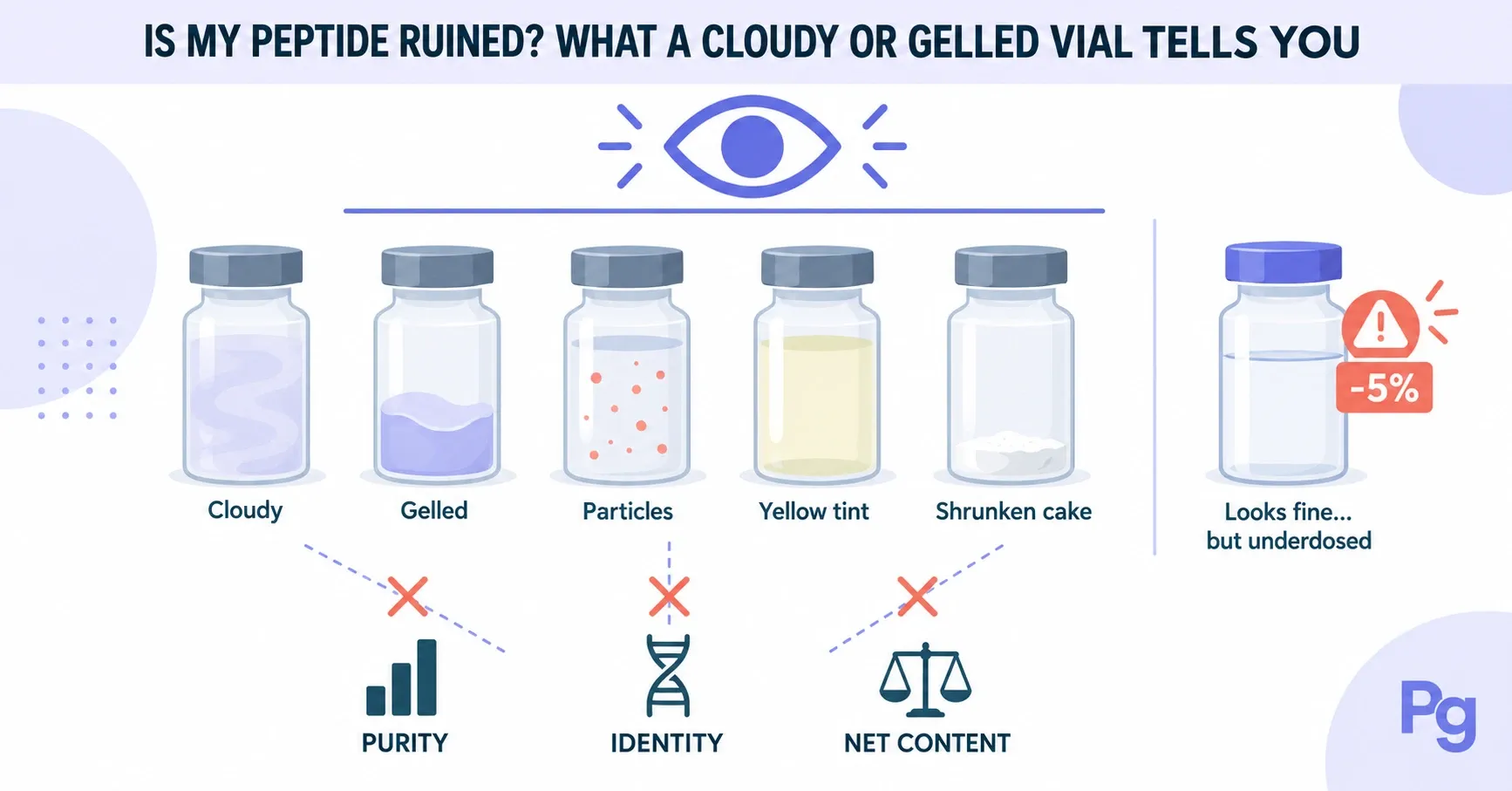
Look for: tracked delivery with estimated timeframes, cold chain shipping (insulated packaging, ice packs or gel packs), tamper-evident seals, and reasonable delivery windows for your location. Lyophilised (freeze-dried) peptide powder arriving in a standard padded envelope at ambient temperature has been exposed to potential degradation. A properly shipped vial arrives in insulated packaging with the lyophilised cake intact—white to off-white, solid, and not discoloured.
Temperature sensitivity varies by peptide. Most lyophilised peptides are stable at room temperature for short transit periods (2–3 days), but extended exposure above 25°C accelerates degradation. Reconstituted peptides are significantly more fragile and require refrigeration (2–8°C) at all times. For European buyers ordering internationally, transit times of 7–14 days through customs make cold chain shipping essential—a gel pack in an insulated box is the minimum acceptable standard. The FDA’s Bacterial Endotoxins/Pyrogens guidance sets the threshold pyrogenic dose at 5 EU/kg body weight for parenteral products—a limit that unregulated peptide vendors are not required to meet but that buyers should expect from any injectable product.
Peptigrity’s Delivery sub-rating (1–5) in community reviews captures buyer experiences with shipping speed, tracking accuracy, and packaging quality. Country flags on peptigrity.com/shops indicate shipping regions—check whether the vendor ships to your country and review the delivery experiences of other buyers in your region.
8. What Purity Standards Does the Shop Claim—and Can You Verify Them?
HPLC purity of 95%+ is acceptable for research-grade peptides. 98%+ is strong. Blanket “>99% purity on all products” claims warrant scrutiny—research-grade rarely achieves consistent >99% across an entire catalogue.
Verify claimed purity against independent lab tests on peptigrity.com/lab-tests. If a vendor claims 99% purity on their BPC-157 but independent HPLC testing shows 91%, the vendor is misrepresenting product quality.
Critical distinction: HPLC purity is not the same as net peptide content. A peptide with 99% HPLC purity may contain only 70–85% active compound by weight—the remainder is water, salts, and counter-ions such as trifluoroacetic acid (TFA). The review “Related impurities in peptide medicines” published in the International Journal of Pharmaceutics confirms that TFA counter-ions, deletion peptides, and residual solvents from solid-phase peptide synthesis are routinely present in final products. Peptigrity’s lab test entries include a stated vs actual quantity comparison that reveals underdosing: a vial labelled 5 mg that tests at 3.8 mg active content is 24% underdosed regardless of its HPLC purity percentage.
For common peptides, the expected purity ranges observed across independent testing on Peptigrity are: BPC-157 typically tests at 97–99.5%, semaglutide at 98–99.8%, and retatrutide at 95–99%. Vendors claiming consistent >99.5% across their entire catalogue should provide verifiable HPLC chromatograms for each batch—not a single generic CoA applied to all products. For deeper guidance on interpreting purity claims, see What Is HPLC Testing and Why It Matters for Peptide Purity.
Price is also a purity signal. The table below shows approximate European market price ranges for common peptides. Prices significantly below these ranges often correlate with lower purity, underdosing, or eliminated quality controls.
Peptide (Dose) | Legitimate Range (€) | Suspicious Range (€) |
BPC-157 (5 mg) | €25–€40 | Below €12 |
Semaglutide (5 mg) | €50–€90 | Below €25 |
Tirzepatide (10 mg) | €70–€130 | Below €35 |
Ipamorelin (5 mg) | €20–€35 | Below €10 |
TB-500 (5 mg) | €25–€45 | Below €12 |
PT-141 (10 mg) | €30–€50 | Below €15 |
Use vendors with trust scores of 4.5+ and ✓ Lab Verified badges on peptigrity.com/shops as your price benchmark. A vendor offering BPC-157 5 mg at €8 when Lab Verified vendors charge €25–40 has cut costs somewhere in the manufacturing or verification chain.
9. Does the Shop Have a Clear Return or Quality-Issue Policy?
A vendor that refuses to address quality issues or shipping damage has planned its exit from accountability before you even place the order.
Research peptides have legitimate return restrictions due to temperature sensitivity and contamination risk. You should not expect standard retail return policies. But a vendor should address: products that fail independent purity testing, shipping damage (broken vials, compromised seals), orders that arrive degraded due to inadequate cold chain packaging, and products that do not match the description or CoA.
Look for a published policy on the vendor’s website that covers quality complaints and shipping damage resolution with a reasonable claim window. Peptigrity’s Service sub-rating reflects how vendors handle disputes in practice—check community reviews for specific experiences with quality-issue resolution. A vendor with a 4.5 Quality rating but a 2.0 Service rating is delivering decent products but failing when problems arise—and problems will arise eventually in any supply chain.
10. Is the Shop Transparent About Its Business Identity?
A legitimate vendor publishes a verifiable physical address or business registration, multi-channel customer support, and consistent brand identity across its web presence.
Look for: a physical address or verifiable business registration number (checkable through national commercial registers—Companies House in the UK, Handelsregister in Germany), a phone number or live chat alongside email, named team members or company leadership, and a consistent social media presence with real engagement (not purchased followers).
Anonymous email-only contact combined with a PO box and no business registration is a high-risk profile. On Peptigrity, shops are marked as either “Claimed” (owner verified identity, manages listing, keeps domain URL current) or “Community Submitted” (added by users, owner has not verified). Claimed status does not affect the trust score, but it indicates active engagement with the verification ecosystem—the shop owner has voluntarily entered a transparency framework.
Research peptide vendors often operate under the “Research Use Only” (RUO) legal framework, which creates legitimate reasons for limited public-facing identity. However, there is a difference between privacy-conscious operation and complete anonymity. A vendor that provides a registered business entity (even if the physical address is not publicly listed) demonstrates accountability that an anonymous vendor does not. For European buyers, verifiable business registration is accessible through national commercial registers and provides a baseline accountability check.
The Complete 10-Point Checklist—Summary
Use this quick-reference checklist before every peptide purchase. Each criterion links to the Peptigrity page where you can verify it.
1. Search the vendor on peptigrity.com/shops. Check trust score (0–5), badge status (✓ Lab Verified vs ⚠ Reviews Only), review count, and lab test count.
2. Check peptigrity.com/lab-tests for independent HPLC purity data. Look for 95%+ purity, recent test dates, and stated vs actual quantity.
3. Verify the CoA is genuine and lot-matched. Confirm the testing lab is listed on peptigrity.com/testing-labs.
4. Read community reviews. Check all 5 sub-ratings (Overall, Quality, Delivery, Service, Pricing) and the “Would buy again” indicator.
5. Verify the domain URL matches the listing on peptigrity.com/shops. Cross-check any links found on Reddit or forums.
6. Confirm the vendor offers at least 1 buyer-protected payment method (credit card or PayPal).
7. Check for cold chain shipping: insulated packaging, ice packs, tracked delivery. Read the Delivery sub-rating in reviews.
8. Compare claimed purity against independent lab test results on peptigrity.com/lab-tests. Understand that HPLC purity ≠ net peptide content.
9. Verify the vendor has a published return or quality-issue policy. Check the Service sub-rating in reviews for dispute resolution experiences.
10. Confirm the shop publishes verifiable business identity: physical address, business registration, or multi-channel support. Check Claimed vs Community Submitted status on Peptigrity.
If a vendor passes all 10 criteria, you are making an informed purchasing decision backed by independent data. If the vendor fails 3 or more criteria, the risk increases substantially. For guidance on what to do when a vendor fails verification, see How to Spot a Scam Peptide Shop: Warning Signs & Red Flags.
Browse all verified peptide shops ranked by trust score to compare vendors. If you have data to contribute—submit a new shop or lab test results to help the community verify more vendors. To learn how to get your own peptides independently tested, visit how to test peptides independently.
Conclusion
The research peptide market has no regulatory body that enforces vendor quality standards for buyers. The responsibility for verification falls on you—and this checklist gives you a structured, repeatable process to fulfil that responsibility.
This checklist is relevant for every peptide buyer, whether purchasing BPC-157 for tissue repair research, semaglutide for metabolic studies, or any other compound. The main benefit is that it converts scattered verification knowledge into a single, prioritised sequence of checks—each mapped to a verifiable data point on peptigrity.com.
The main limitation is that no checklist eliminates risk entirely in an unregulated market. A vendor that passes all 10 criteria today can deteriorate in quality tomorrow. This is why Peptigrity’s trust scores auto-recalculate with every new review and lab test—the data stays current even when your checklist was completed weeks ago.
The 3 key takeaways: start every vendor evaluation on peptigrity.com/shops (trust score, ✓ Lab Verified badge, reviews, lab tests), verify purity claims against independent lab test results rather than trusting vendor-supplied CoAs alone, and use the 10-point checklist as a repeatable protocol—not a one-time exercise. Verification is not a one-off task; it is a habit that protects your investment and your safety every time you order.
For background on why these criteria matter and what happens when buyers skip verification, see How to Verify Peptide Quality Before You Buy and How to Spot a Scam Peptide Shop: Warning Signs & Red Flags. For the methodology behind the trust scores referenced throughout this checklist, see how we calculate trust scores. As Dr. Thomas O’Connor (“The Anabolic Doc”) has emphasised in clinical practice, verifying the source and quality of any injectable compound is not optional—it is a prerequisite for safe use.
This article is for informational and educational purposes only and does not constitute medical advice. Research peptides are not approved for human consumption by the FDA or EMA. Always consult a qualified physician before using any peptide product. Peptigrity is an independent review platform with no financial relationship to any listed shop, manufacturer, or testing laboratory.