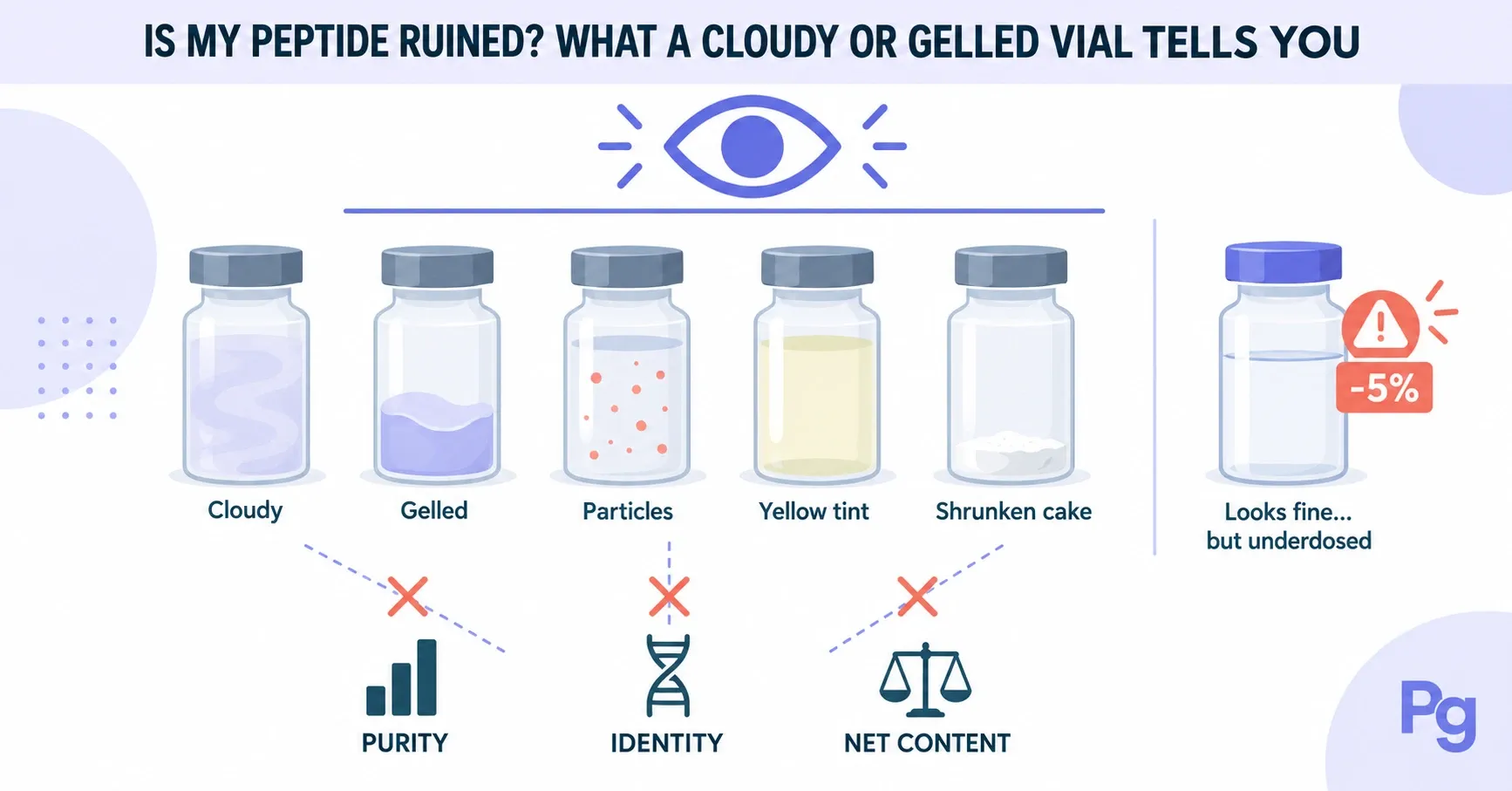
Scam peptide vendors cost buyers money, expose them to contaminated products, and erode trust across the entire research peptide market. As of March 2026, Peptigrity tracks peptide shops with independent lab tests and community reviews (currently 131 shops, 600+ lab tests, and 1,038+ reviews—growing daily)—and even with this coverage, approximately 40% of vendors in the broader market display at least 1 significant red flag when evaluated against documentation standards, business legitimacy, and product verification criteria.
The 3 categories of peptide fraud are exit scams, quality fraud, and documentation fraud. This article breaks down 7 common scam patterns, explains how to verify a Certificate of Analysis (CoA), identifies pre-order red flags, and provides a 10-step buyer safety checklist—with every verification step mapped to a specific tool on peptigrity.com. For the structured checklist version, see What to Look for in a Peptide Shop: A Buyer’s Checklist. The scale of this problem is not theoretical: INTERPOL’s Operation Pangea XVII (December 2024–May 2025) seized 50.4 million doses of illicit pharmaceuticals worth USD 65 million across 90 countries, with peptide supplements flagged as an emerging enforcement category.
For a broader quality verification framework, start with How to Verify Peptide Quality Before You Buy.
What Makes Peptide Shops Vulnerable to Scams?
Research peptides operate in a regulatory grey area between pharmaceutical-grade medications and unregulated supplements. The U.S. Food and Drug Administration (FDA) classifies most non-approved peptides under the “Research Use Only” (RUO) label, which means they are not subject to the same oversight as prescription drugs. No single regulatory body monitors research peptide consumer fraud—which is precisely why independent verification platforms like Peptigrity exist.
The FDA’s Category 2 list, introduced in late 2023, placed 19 peptides—including BPC-157 and Thymosin Alpha-1—under restrictions that prevent licensed compounding pharmacies from producing them under Sections 503A and 503B of the Federal Food, Drug, and Cosmetic Act. The legal consequences of violating these rules are real: the DOJ prosecution of Tailor Made Compounding LLC resulted in a guilty plea for distributing unapproved drugs (including BPC-157 and SARMs) and a $1,788,906 forfeiture. In February 2026, Health Secretary Robert F. Kennedy Jr. announced plans to reclassify several Category 2 peptides back to Category 1, signalling a potential regulatory shift. The practical effect of this uncertainty is that grey-market vendors exploit the confusion to sell unverified products with limited accountability.
The March 2026 voluntary shutdown of Peptide Sciences—one of the largest grey-market vendors—triggered immediate market disruption. Clone websites mimicking Peptide Sciences’ branding appeared within days. Buyers who found vendor links on Reddit, forums, or search results had no reliable way to verify whether a domain was genuine—unless they cross-referenced it against a platform like Peptigrity’s shop directory, where claimed shops keep their domain URLs current.
Demand amplification from GLP-1 receptor agonists (semaglutide, tirzepatide) and wellness-influencer promotion further attracts fraudulent sellers. Europol’s Operation SHIELD VI (April–November 2025) prosecuted 3,354 individuals and seized €33 million worth of counterfeit medicines across 30 countries, with counterfeit semaglutide-based products specifically highlighted as an emerging threat.
What Are the 7 Most Common Peptide Scam Patterns?
The 7 most common peptide scam patterns are exit scams, fabricated CoAs, counterfeit or mislabelled products, subscription traps, cloned vendor websites, astroturfed reviews, and price manipulation. Each pattern targets a different vulnerability in the buyer’s verification process.
1. Exit Scam (Non-Delivery Fraud)
The vendor accepts payment—typically via cryptocurrency, wire transfer, or Zelle—then never ships the product. The domain disappears within 2–4 weeks. Irreversible payment methods are the defining feature.
How Peptigrity helps detect it: Check if the shop exists on peptigrity.com/shops. A vendor with 0 reviews, 0 lab tests, and no listing has no verified track record. Shops with review history and a ✓ Lab Verified badge are significantly less likely to be exit scams.
2. Fabricated Certificate of Analysis (CoA)
A fake CoA is a generic PDF showing high purity values (often exactly 99.0%) with no verifiable lot number, no named third-party laboratory, and no matching chromatogram. Research published in the journal International Journal of Pharmaceutics titled “Related impurities in peptide medicines” documents how solid-phase peptide synthesis (SPPS) produces deletion peptides, diastereomeric impurities, counter-ion contamination, and cross-contamination with unrelated peptides—impurities that only proper HPLC and mass spectrometry can detect. A CoA without these analytical methods is meaningless.
How Peptigrity helps detect it: Check peptigrity.com/lab-tests for independent HPLC results on that vendor’s products. If the vendor has no lab tests on Peptigrity, their CoA claims are unverified.
3. Counterfeit or Mislabelled Product
The vial contains the wrong amino acid sequence, a degraded compound, or an entirely different substance. A study in Clinical Chemistry and Laboratory Medicine titled “Impurity profiling quality control testing of synthetic peptides” found that from 5 peptide manufacturers tested, one product was an entirely different peptide and two-thirds of tested samples had purity insufficient for experiments (below 95% or individual impurities exceeding 1%). The DOJ’s prosecution of Paradigm Peptides found that products advertised as SARMs actually contained testosterone—a controlled substance.
How Peptigrity helps detect it: Compare the vendor’s claimed purity with independent lab test results on Peptigrity.
4. Subscription Trap
The buyer unknowingly consents to recurring billing through fine-print clauses at checkout. Cancellation requires contacting support channels that are slow, unresponsive, or nonexistent.
How Peptigrity helps detect it: Read community reviews on the shop’s Peptigrity page. Buyers report billing issues in the Pricing and Service sub-ratings.
5. Cloned Vendor Website
After a legitimate vendor shuts down, scammers clone the website design, product catalogue, and brand identity. They alter only the payment portal. Post-Peptide Sciences clones are a current example.
How Peptigrity helps detect it: Always verify the correct domain URL on peptigrity.com/shops. Claimed shops keep their URLs current.
6. Astroturfed Reviews
Fake positive reviews cluster around the same posting dates, use identical phrasing, and lack product-specific details. When 15+ reviews appear in the same week with phrases like “great product, fast shipping,” the pattern is almost certainly fabricated.
How Peptigrity helps detect it: Peptigrity’s review system requires registration, limits 1 review per shop per user, and moderates for duplication. Each review displays 5 sub-ratings, making fake patterns easier to identify. Read community buyer reviews.
7. Price Manipulation
A vendor lists peptides at 30%+ below market average. Legitimate BPC-157 (5 mg) costs approximately €25–€40. A price of €8–€12 signals that synthesis purity, analytical testing, or quality documentation has been eliminated.
How Peptigrity helps detect it: Compare prices against vendors with trust scores of 4.5+ and ✓ Lab Verified badges on peptigrity.com/shops.
How Do You Verify a Peptide Certificate of Analysis Is Real?
Start by checking peptigrity.com/lab-tests, where independent HPLC purity results are published with CoA images, test dates, and testing lab names. This is the fastest first-line verification: free, instant, and based on independently submitted data. If no results exist, use peptigrity.com/testing-labs to find a laboratory and submit your own sample.
Lot-Matching
Every CoA must reference a specific batch/lot number that corresponds to the label on the physical vial. A single CoA reused across multiple batches is unreliable. Lot-matching creates a chain of custody between manufacturing, testing, and the product you receive.
HPLC Chromatogram Interpretation
High-Performance Liquid Chromatography (HPLC) measures purity by separating the target peptide from UV-absorbing impurities. A legitimate chromatogram shows a dominant peak with minimal secondary peaks. Purity values of 95–99%+ are standard for research-grade peptides. A CoA listing only a typed number without the actual chromatogram is incomplete. The peer-reviewed study “Peptide Impurities in Commercial Synthetic Peptides and Their Implications for Vaccine Trial Assessment” demonstrated that even contamination levels as low as 1% of total peptide weight can produce measurable biological effects—making accurate HPLC analysis essential for any research application. HPLC purity data carries 60% weight in Peptigrity’s trust score formula.
Mass Spectrometry Identity Confirmation
Mass spectrometry (MS)—commonly MALDI-TOF or ESI-MS—confirms the molecular weight of the peptide, verifying it is the correct amino acid sequence. HPLC confirms purity; mass spec confirms identity. A CoA without mass spectrometry data only tells you how pure the substance is, not what the substance actually is.
Third-Party vs. In-House Testing
Independent third-party testing is the gold standard. In-house testing means the vendor tested its own product—a conflict of interest. Peptigrity’s testing labs directory lists 9 independent laboratories, including Janoshik Analytical (Czech Republic), Freedom Diagnostics (USA), and Vanguard Laboratory (USA). If the CoA names a testing lab, check whether that lab is listed on Peptigrity’s directory.
Purity vs. Net Peptide Content
Purity and net peptide content are 2 different metrics. Purity (HPLC) reflects the proportion of target peptide relative to impurities. Net peptide content reflects actual active peptide versus total mass—including water, counter-ions such as trifluoroacetic acid (TFA) salts, and residual solvents. A peptide with 98% purity may have only 70–80% net peptide content. The review “Related impurities in peptide medicines” published in the International Journal of Pharmaceutics confirms that unwanted counter-ions originating from SPPS and purification treatments are routinely present in final peptide products.
For a step-by-step guide on reading lab reports, see How to Read Peptide Lab Test Results: HPLC & Mass Spec Explained. For a deep dive into chromatographic methods specifically, see What Is HPLC Testing and Why It Matters for Peptide Purity. To submit your own sample, visit how to test peptides independently.
What Red Flags Should You Check Before Ordering?
There are 8 pre-order red flags, and your first 5 checks should use Peptigrity’s platform before moving to supplementary tools.
1. Search the Shop on Peptigrity
Go to peptigrity.com/shops and search for the vendor. Does it exist? What is its trust score (0–5 scale)? A vendor with no listing has no independently verified track record.
2. Check for the ✓ Lab Verified Badge
Shops with both community reviews AND independent lab test data display a ✓ Lab Verified badge with a test count. This is the strongest trust signal on the platform. Shops marked “⚠ Reviews Only” have no independent purity verification.
3. Read Community Reviews
Peptigrity’s community reviews provide richer data than any algorithmic trust score. Each review has 5 sub-ratings: Overall, Quality, Delivery, Service, and Pricing—plus a “Would buy again” indicator. Reviews are moderated but never edited; negative reviews are not suppressed.
4. Verify the Domain URL
Claimed shops on Peptigrity keep their domain URL current. Always check peptigrity.com/shops for the correct, active domain before visiting any peptide vendor. This is critical post-Peptide Sciences shutdown, when clone domains proliferated.
5. Check for Independent Lab Tests
Visit peptigrity.com/lab-tests and search for the vendor’s products. If independent HPLC purity data exists, compare it to the vendor’s claims.
6–8. Supplementary Checks
After completing Peptigrity-based checks: verify domain age via WHOIS, confirm the vendor offers buyer-protected payment (credit card), and verify a clear return policy exists. Cryptocurrency-only payment, missing contact information, and prices 30%+ below market remain red flags regardless of Peptigrity listing status.
Why Are Suspiciously Low Peptide Prices a Danger Signal?
Peptide prices reflect real manufacturing costs: solid-phase peptide synthesis (SPPS), HPLC purification, analytical testing, quality assurance documentation, lyophilisation (freeze-drying), and cold chain shipping. When a vendor undercuts the market by 30%+, at least 1 of these steps has been eliminated.
Use Peptigrity’s shop directory to benchmark prices. Vendors with trust scores of 4.5+ and ✓ Lab Verified badges establish the legitimate price range.
Peptide (Dose) | Legitimate Range (€) | Suspicious Range (€) |
BPC-157 (5 mg) | €25–€40 | Below €12 |
Semaglutide (5 mg) | €50–€90 | Below €25 |
Tirzepatide (10 mg) | €70–€130 | Below €35 |
Ipamorelin (5 mg) | €20–€35 | Below €10 |
TB-500 (5 mg) | €25–€45 | Below €12 |
PT-141 (10 mg) | €30–€50 | Below €15 |
Melanotan II (10 mg) | €20–€35 | Below €10 |
When a vendor with no independent lab test results offers prices far below these benchmarks, treat the listing with extreme caution.
Can Fake Peptides Cause Health Problems?
Counterfeit, contaminated, or mislabelled peptides pose direct health risks because injectable products bypass the body’s natural biological safety barriers. The 5 primary risks are bacterial contamination (endotoxins), heavy metal contamination, wrong amino acid sequence, underdosing or overdosing, and residual solvent toxicity.
Endotoxin testing using the Limulus Amebocyte Lysate (LAL) assay is critical for injectable peptides. The FDA sets the endotoxin limit at 5 EU/kg body weight for injectable products. Some laboratories on Peptigrity’s testing labs directory—such as Liquilabs—offer endotoxin screening alongside HPLC purity analysis.
The scale of enforcement reflects the severity. INTERPOL’s Operation Pangea XVII resulted in 769 arrests and the seizure of USD 65 million in illicit pharmaceuticals across 90 countries. INTERPOL specifically flagged peptide supplements (BPC-157, ipamorelin, melanotan) as an emerging enforcement category due to growing demand in high-income countries. Separately, Europol’s Operation SHIELD VI prosecuted 3,354 individuals and highlighted counterfeit semaglutide-based products as a critical public health threat.
Dr. Paul Knoepfler, a cell and molecular biologist at UC Davis, has publicly warned that research-grade peptides purchased from unregulated sources carry contamination risks that pharmaceutical-grade manufacturing controls are designed to prevent. Dr. Thomas O’Connor (“The Anabolic Doc”) has similarly emphasised from clinical practice that peptide quality verification is essential before any research or clinical application.
For context on specific peptides commonly targeted by counterfeiters, see Peptigrity’s guides on BPC-157, semaglutide, and tirzepatide.
How Do Legitimate Peptide Vendors Differ from Scam Shops?
Legitimate peptide vendors differ from scam shops across 8 verifiable criteria—all visible on Peptigrity’s platform.
Criterion | Legitimate Vendor | Scam Shop |
Trust Score | 4.5–5.0 with ✓ Lab Verified | No listing or below 2.0 |
Lab Tests | Multiple HPLC results on /lab-tests | 0 tests on Peptigrity |
Reviews | 100+ reviews, balanced sub-ratings | 0 reviews or astroturfed cluster |
Domain URL | Verified via claimed Peptigrity listing | Unverifiable, clone risk |
Payment | Credit card + alternatives | Crypto only or wire only |
Shipping | Cold chain, tracked, insulated | Standard mail, no temp control |
CoA Quality | Lot-matched, third-party, chromatogram | Generic PDF, no lot number |
Return Policy | Clear quality-complaint process | No returns or hidden refusal clauses |
The principle: audit the supplier through Peptigrity’s data, not the product page. For the full methodology, see how trust scores are calculated.
What Tools Can You Use to Investigate a Peptide Vendor?
Peptigrity is the primary investigation tool. Start with Peptigrity, then use supplementary tools.
Step 1: Search peptigrity.com/shops
Enter the vendor name on peptigrity.com/shops. Check trust score (0–5), ✓ Lab Verified badge, review count, and lab test count.
Step 2: Check Independent Lab Tests
Visit peptigrity.com/lab-tests. The database contains independent HPLC purity tests with peptide name, brand, purity percentage, test date, and testing lab.
Step 3: Find a Testing Lab
Use peptigrity.com/testing-labs (9 labs). HPLC purity analysis costs $50–$100 per sample with 5–10 day turnaround. For a full guide, see how to test peptides independently.
Step 4: Read Community Reviews
Browse community buyer reviews with 5 sub-ratings and a “Would buy again” indicator.
Step 5: Verify the Domain URL
Claimed shops maintain current domains. Use peptigrity.com/shops as your navigation starting point.
Step 6: Supplementary Tools
WHOIS lookup for domain age, Reddit r/peptides and r/sarmssourcetalk for community data, reverse image search on product photos, and business registration verification through national commercial registers.
What Should You Do If You Have Been Scammed by a Peptide Shop?
Your 5 immediate actions: initiate a chargeback, report to authorities, document evidence, warn the community on Peptigrity, and submit lab test results.
Initiate a Chargeback
Contact your credit card issuer within 120 days. Cryptocurrency and wire payments are irreversible.
Report to Authorities
EU: ECC-Net for cross-border purchases. US: FTC and state attorney general. These reports build enforcement databases.
Warn Other Buyers
Leave a review on the shop’s Peptigrity page. If unlisted, submit the shop via peptigrity.com/add/shop.
Submit Lab Test Results
If you have the product tested independently, submit results to Peptigrity. Published purity data protects future buyers.
How Is the Peptide Regulatory Landscape Changing in 2026?
The 2026 landscape is defined by 3 developments: the FDA reclassification announcement, the semaglutide compounding controversy, and the Peptide Sciences shutdown.
FDA Reclassification (February 2026)
Health Secretary Kennedy Jr. announced several Category 2 peptides would return to Category 1, enabling compounding under USP 797/795 standards. This does not regulate the grey-market RUO vendor space.
Semaglutide Compounding Controversy
The Biologics Price Competition and Innovation Act (BPCIA) governs semaglutide compounding eligibility. High demand has made semaglutide one of the most counterfeited peptides—and one of the most tested on Peptigrity’s lab tests page.
Peptide Sciences Shutdown and Clone Scams
Any website claiming to be Peptide Sciences after March 2026 is fraudulent. Verify vendor domains against peptigrity.com/shops.
Peptide Buyer Safety Checklist: Your Pre-Order Verification Protocol
Complete these 10 verification steps before placing any peptide order.
1. Search the vendor on peptigrity.com/shops. Check trust score (0–5), badge status, review count, lab test count.
2. Look for the ✓ Lab Verified badge—shops with both reviews AND lab tests carry the strongest trust signal.
3. Read community reviews. Check all 5 sub-ratings and the “Would buy again” indicator.
4. Verify the domain URL matches peptigrity.com/shops. Claimed shops keep URLs current.
5. Check peptigrity.com/lab-tests for independent HPLC purity data.
6. Confirm the CoA testing lab is listed on peptigrity.com/testing-labs.
7. Check domain age via WHOIS lookup.
8. Verify payment options include buyer-protected methods (credit card).
9. Confirm a return/quality-issue policy exists.
10. Start with a small test order before larger purchases.
Browse all verified peptide shops ranked by trust score. Peptigrity’s trust score integrates reviews (40%) and HPLC purity (60%)—with no advertising, no affiliate commissions, and no paid rankings. See how trust scores are calculated.
Conclusion
Peptide scams target buyers who skip verification. The grey-market peptide space operates without standardised consumer protection, which means verification responsibility falls on the buyer.
The main risks of skipping verification are financial loss through exit scams, health complications through contaminated or mislabelled products, and wasted research through underdosed compounds.
The 3 key takeaways: always start your vendor check on peptigrity.com/shops, verify purity claims against independent lab test results rather than trusting vendor-supplied CoAs alone, and complete the 10-step checklist before every order. Peptigrity exists to reduce the information asymmetry between buyers and vendors—use it.
This article is for informational and educational purposes only and does not constitute medical advice. Research peptides are not approved for human consumption by the FDA or EMA. Always consult a qualified physician before using any peptide product. Peptigrity is an independent review platform with no financial relationship to any listed shop, manufacturer, or testing laboratory.